← Back to Library

A collection of expository articles, seminar slides, and final course projects. Unlike research papers, the goal of these documents is pedagogical: to introduce specific topics, survey existing literature, or present classical proofs in a more accessible language.

Number Theory Probability

A cluster of great formulas

Probabilistic Theory of Numbers • (2026-1)

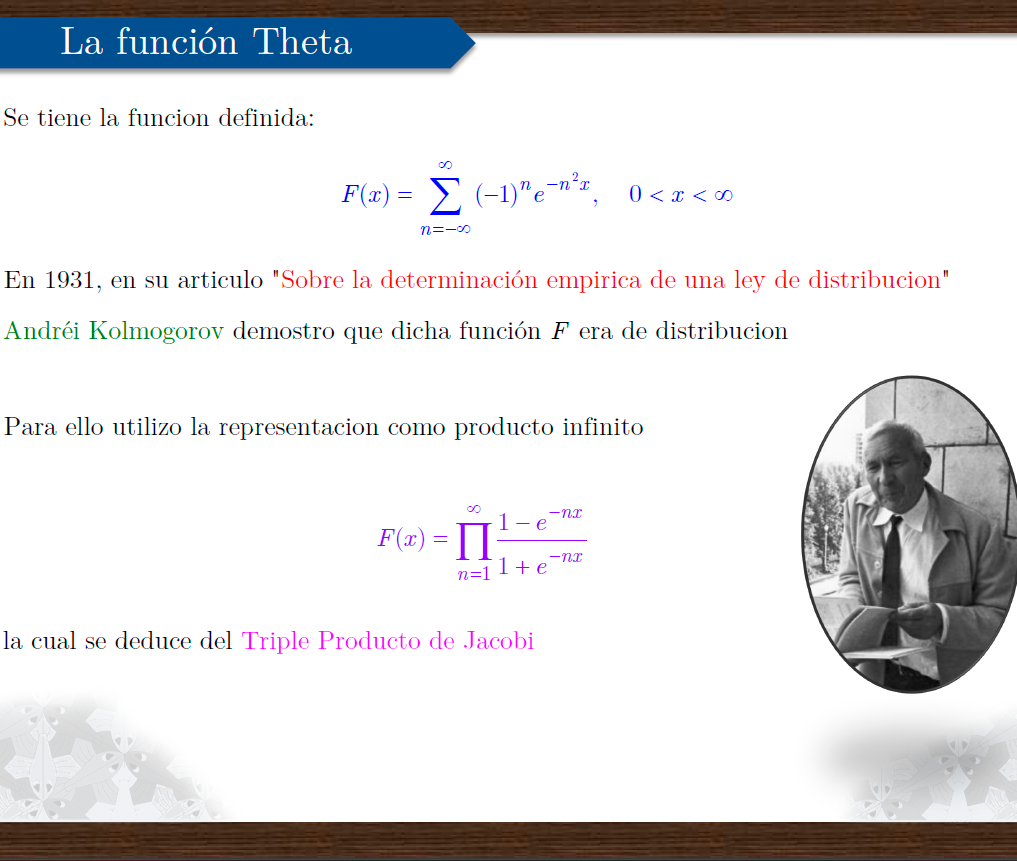
Based on K. L. Chung's article "A Cluster of Great Formulas", this talk validates the Theta function $F(x)=\sum_{n=-\infty}^{\infty}(-1)^{n}e^{-n^{2}x}$ as a cumulative distribution function using two stochastic approaches. We first identify it as the distribution of the supremum of a random sequence via the Jacobi Triple Product, and subsequently, by analyzing its Laplace transform with Euler's sine product formula, we characterize it as the distribution of a weighted sum of independent exponential variables.
Preview
Number Theory Probability Formulas

De Dirichlet a Esperanzas ¿O al revés?

Probabilistic Theory of Numbers • (2025-2)

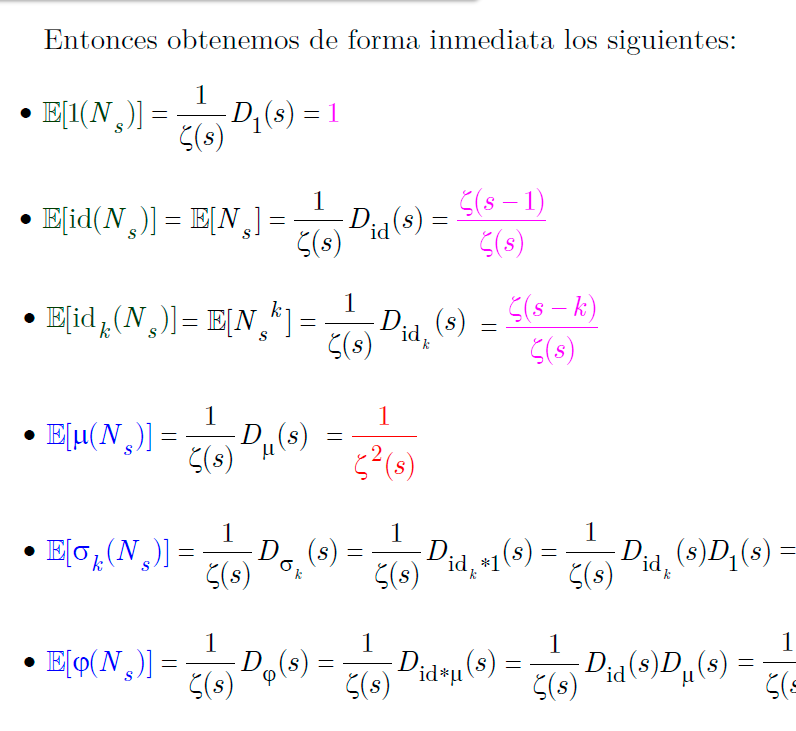
This talk bridges analytic number theory and probability by interpreting Dirichlet Series as expectations of arithmetic functions, established via the fundamental identity $\mathbb{E}[f(N_s)] = \frac{1}{\zeta(s)}D_f(s)$. We utilize multiplicative functions and Dirichlet convolution to compute explicit expectations for classical functions like Von Mangoldt's $\Lambda$ and derive complex variance formulas for the Möbius function $\mu$ and Euler's totient $\varphi$.

Preview
Number Theory Probability Article

EULER’S FORMULAE FOR $\zeta(2n)$ AND PRODUCTS OF CAUCHY VARIABLES

Probabilistic Theory of Numbers • (2025-2)

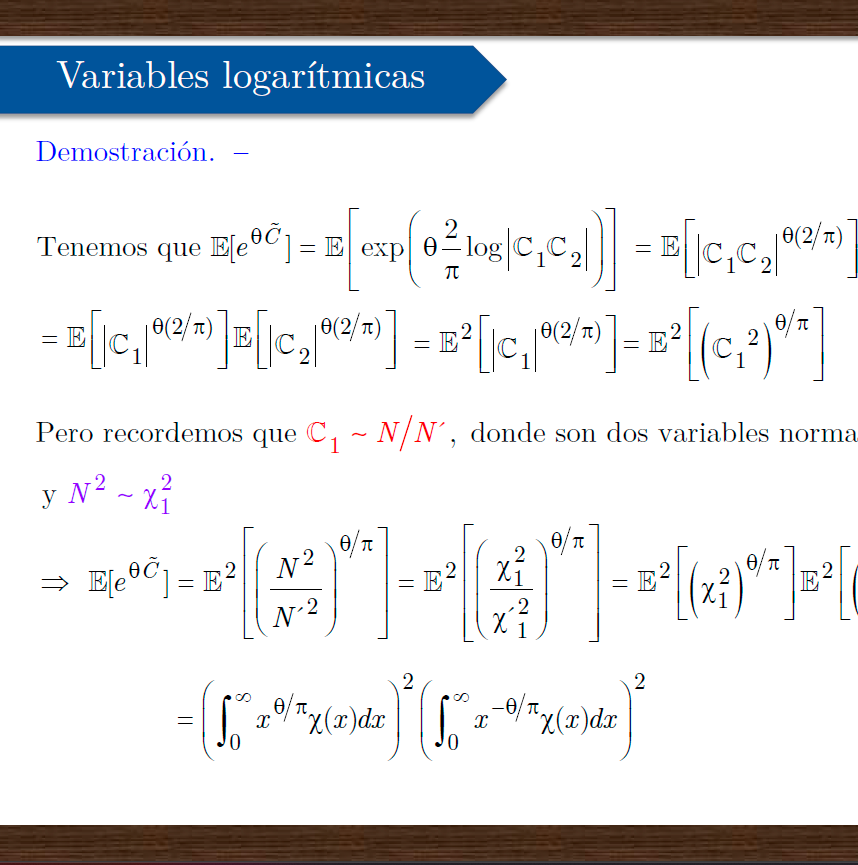
Based on the article "EULER’S FORMULAE FOR $\zeta(2n)$ AND PRODUCTS OF CAUCHY VARIABLES", this talk contrasts Euler's classical derivation using the sine product formula with a novel stochastic proof. We demonstrate how evaluating the moments of the log-product of independent Cauchy variables, $\Lambda = \log|\mathbb{C}_1\mathbb{C}_2|$, via both direct integration and moment generating functions (linking to Secant numbers), recovers the exact values of the Riemann zeta function at even integers.

Preview
Number Theory Probability Article

A Stochastic Approach to the Gamma Function

Probabilistic Theory of Numbers • (2025-2)

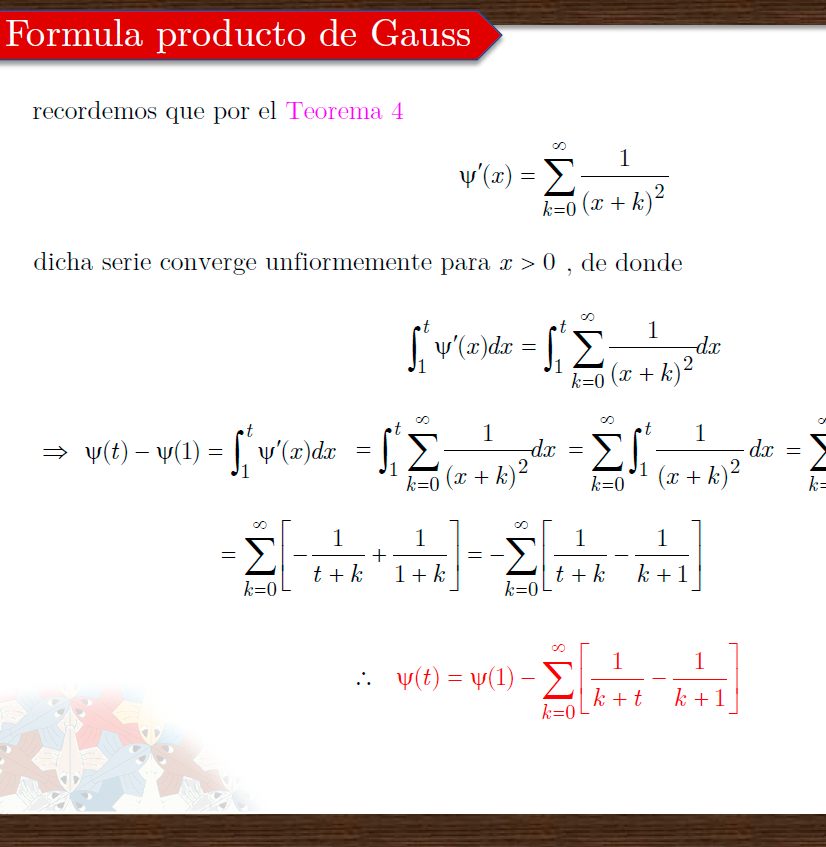
Based on the article "A Stochastic Approach to the Gamma Function", this talk employs a probabilistic framework to derive key properties of $\Gamma(t)$. We prove Stirling's formula via bounds on polygamma functions, deduce Gauss's multiplication theorem from products of independent Gamma variables, and obtain Euler's reflection formula by analyzing the expectation of log-differences of exponential variables.

Preview
Combinatorics Solve problems

Ecuación General de Recurrencias lineales con coeficientes constantes

Foundations of Combinatorics • (2023-2)

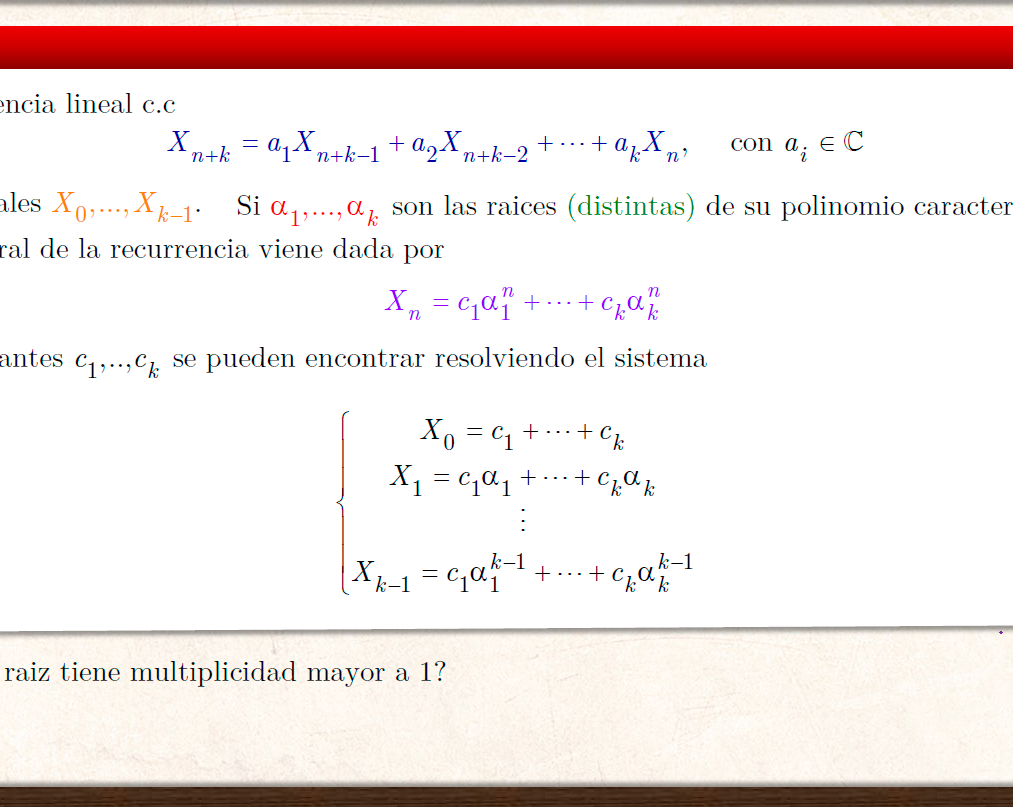
This talk provides a structured introduction to Linear Recurrence Relations with Constant Coefficients. We begin by formalizing the definition of such sequences and characterizing the set of solutions for homogeneous recurrences as a vector space over \(\mathbb{C}\). Two analytical methods for finding the general formula are presented: the Linear Method, which utilizes the roots of the characteristic equation—accounting for algebraic multiplicity —and the Series Method, which applies ordinary generating functions and partial fraction decomposition to solve both homogeneous and non-homogeneous systems.

View Slides
Watch Video
Preview
Complex Analysis History Formulas

La función zeta en los números naturales

Complex Analysis III • (2023-1)

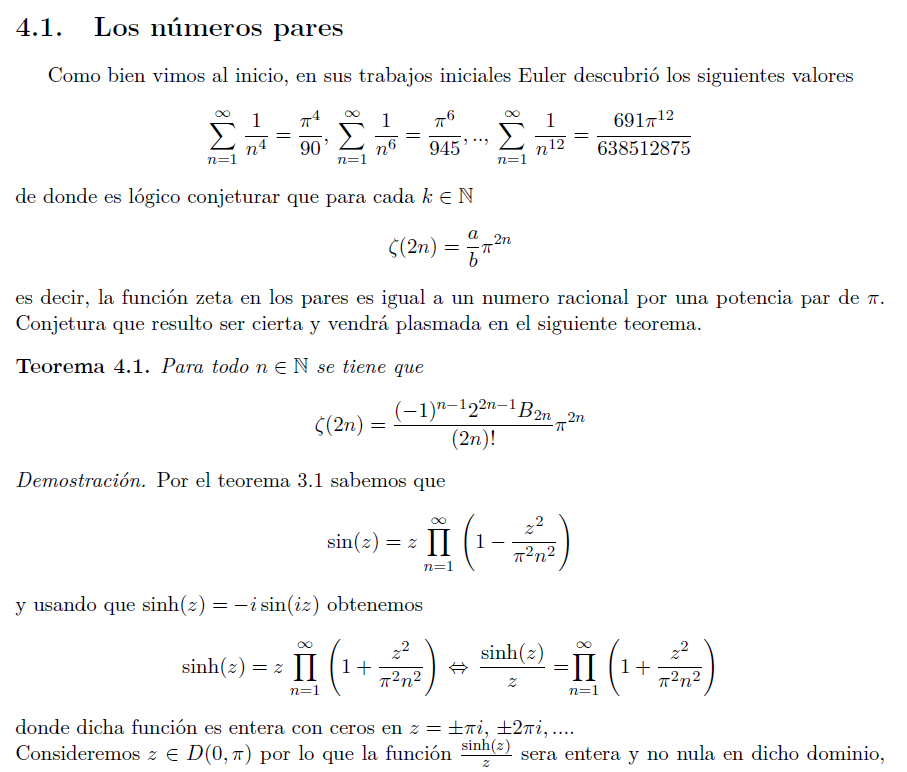
This talk studies the values of the Riemann zeta function \(\zeta(s)\) at integer arguments. We review Euler’s evaluation of the even values \(\zeta(2n)\) in terms of powers of \(\pi\) and Bernoulli numbers, and discuss the striking contrast with the odd values \(\zeta(2n+1)\), whose arithmetic nature remains largely mysterious. The presentation highlights known results, partial irrationality theorems, and open problems related to special values of \(\zeta(s)\).

Preview
Algebra History

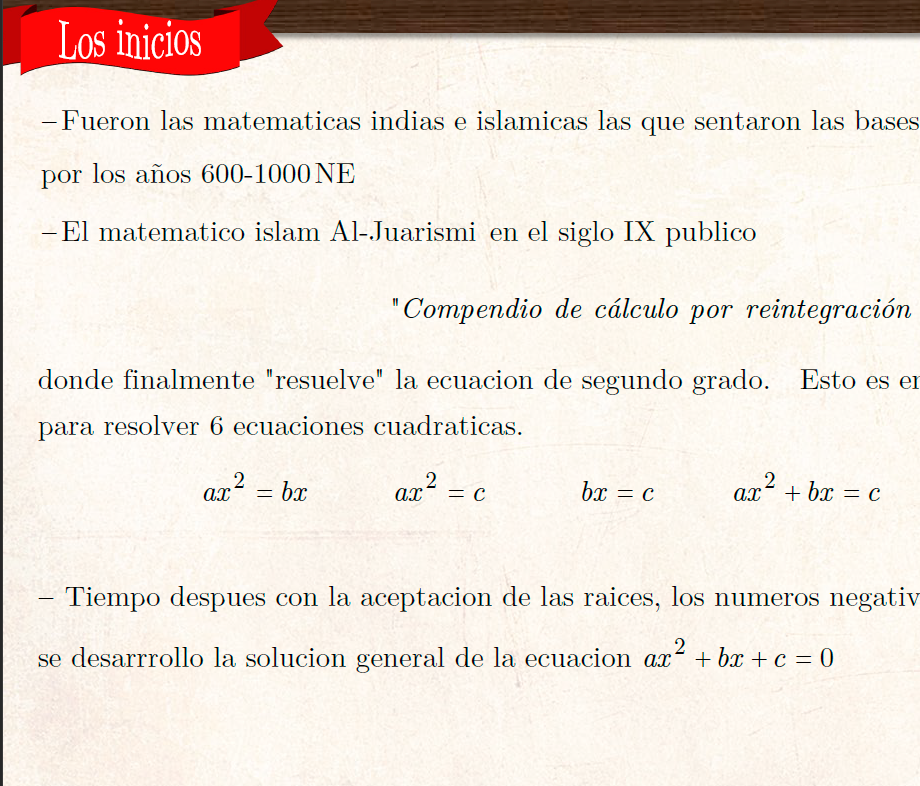
Teorema Fundamental de Algebra

Modern Algebra II • (2022-2)

This talk presents a historical and algebraic approach to the Fundamental Theorem of Algebra. It traces the development of polynomial equations from early quadratic and cubic methods to the introduction of complex numbers, and then focuses on a modern proof based on field extensions, algebraic elements, and algebraic closures. The presentation emphasizes the idea that the field \(\mathbb{C}\) is algebraically closed and explains how this property guarantees that every non-constant polynomial with real coefficients has at least one complex root.

View Slides
Watch Video
Preview
Complex Analysis Solve Problems

Soluciones Ejercicios 10 y 11

Complex Analysis I • (2022-1)

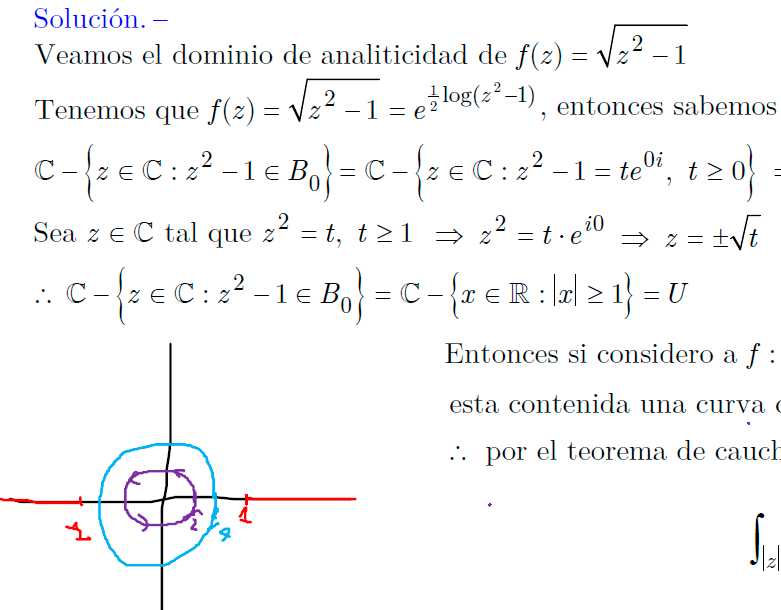
This talk presents detailed solutions to two classical problems from Complex Analysis I. The first problem establishes the trigonometric identity \(\prod_{k=1}^{n-1} \sin\!\left(\frac{k\pi}{n}\right) = \frac{n}{2^{\,n-1}}\), using roots of unity and elementary properties of complex exponentials. The second problem evaluates a complex integral involving a branch of the square root function, emphasizing domains of analyticity, branch cuts, and an application of Cauchy’s theorem.

View Slides
Watch Video
Preview
Number Theory History

Capitulo 12: “Phifofu”

Recreations in Number Theory • (2022-1)

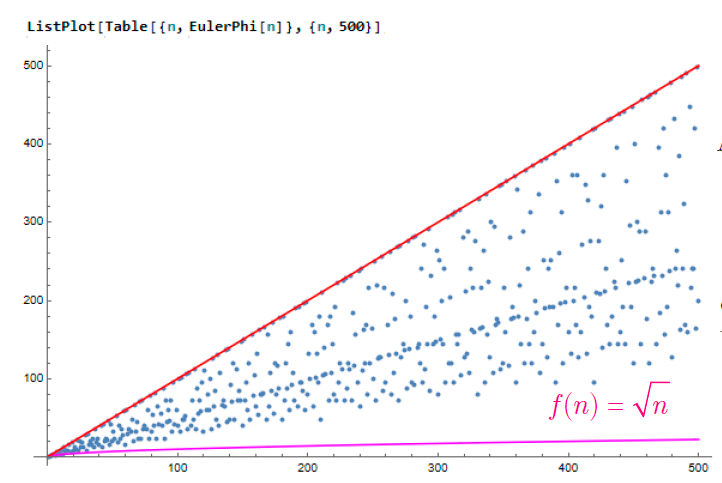
This talk explores the Euler totient function \(\varphi(n)\), its definition, fundamental properties, and its multiplicative structure. We discuss explicit formulas for computing \(\varphi(n)\) via prime factorization, derive general bounds for its growth, and study several equations and divisibility problems involving \(\varphi(n)\). The presentation concludes with an introduction to classical open problems, including Lehmer’s problem and Carmichael’s conjecture on the non-injectivity of the totient function.

Preview
Number Theory History

Capitulo 3: “Perfección”

Recreations in Number Theory • (2022-1)

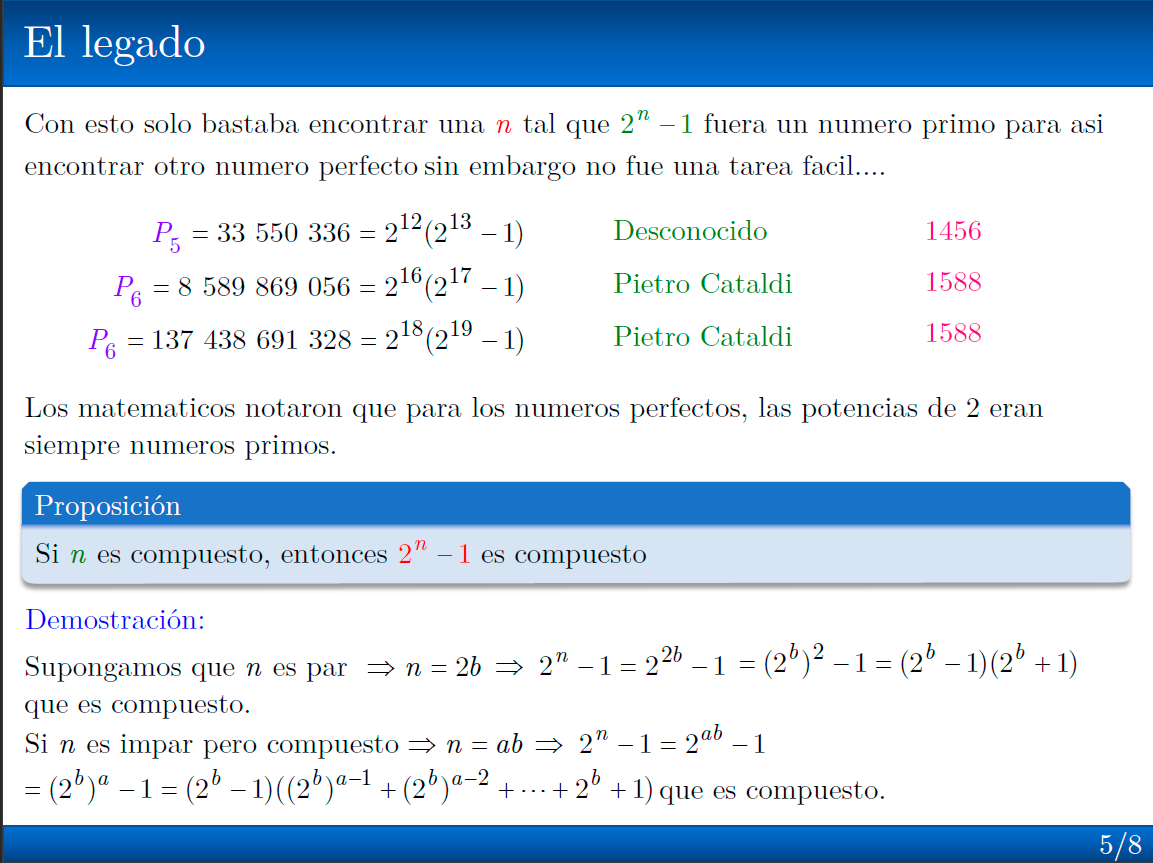
This talk presents a historical and mathematical overview of perfect numbers, defined as integers \(N\) satisfying \(\sigma(N) = 2N\). We discuss classical examples, Euclid’s construction \(N = 2^{p-1}(2^p - 1)\) for Mersenne primes, and Euler’s theorem showing that this formula characterizes all even perfect numbers. The talk concludes with a discussion of odd perfect numbers and their status as a long-standing open problem in number theory.

Preview

* These documents were written during my formative years and are not peer-reviewed.

← Back to Library